
Many companies treat intellectual property (IP) as a secondary task, only looking at protection once a product is already on the market or a dispute arises. In modern commerce, a brand’s concepts, unique identities, and technical breakthroughs are frequently its most critical capital. Ignoring proactive management introduces major financial and operational vulnerabilities.
Integrating a comprehensive IP roadmap ensures that every creative milestone and technical advancement reinforces overarching corporate targets. Instead of viewing legal protections as scattered paperwork, a deliberate methodology synchronizes your legal choices directly with profitability, expansion, and market differentiation.
The IP GOAL Framework
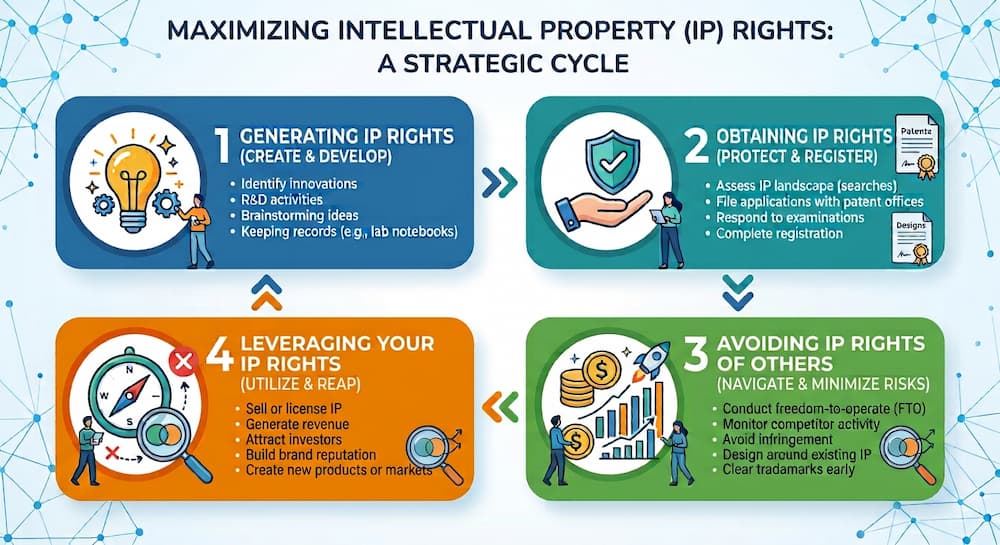
Navigating intangible assets becomes significantly simpler using a four-phase structure:
- Generating IP rights: Establishing internal workflows to spot, document, and claim ownership of new brand elements and innovations right as they emerge.
- Obtaining IP rights: Selecting the correct jurisdictions and registration pathways to establish solid, enforceable legal barriers efficiently.
- Avoiding IP rights of others: Conducting due diligence clearance checks and tracking industry trends to keep daily business functions clear of third-party infringement.
- Leveraging IP rights: Utilizing secured assets to block competitors, qualify for tax benefits, draw in investors, and open up licensing income channels.
Transition From Reactive to Proactive
Operating without a clear plan frequently leads businesses into expensive missteps, such as:
- Accidentally forfeiting patent eligibility by revealing an invention publicly prior to submission.
- Pouring funds into a brand identity launch without realizing another entity holds the prior trade mark.
- Engaging external contractors or freelancers without executing proper written copyright assignment documents.
- Funding registrations in regions where the enterprise has zero commercial footprint.
Shifting to an organized framework swaps out chaotic firefighting for intentional value building, converting intellectual property from a simple legal expense into a core asset for enterprise valuation.
Want to find out more?
Explore the 4-Part IP GOAL Series
- Generating Intellectual Property Rights for Your Company
Uncover techniques for spotting hidden intangible assets, setting up capture habits, and preserving trade secrets. - Obtaining Intellectual Property Rights for Your Company
Master the process of prioritizing filings, selecting optimal regions, and developing an efficient portfolio. - Avoiding the Intellectual Property Rights of Others
Learn how to execute clearance checks, audit competitors, and mitigate infringement exposures. - Leveraging Your Intellectual Property Rights
Investigate strategies to monetize portfolios via licensing agreements, tax schemes, and smart positioning.
If you would like to talk to us about what your options are, please contact us.