
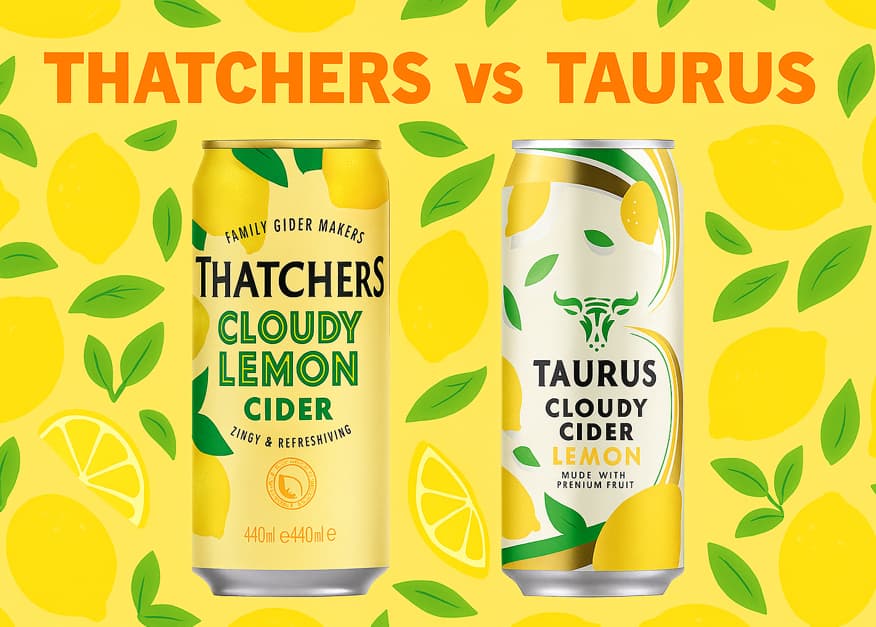
Have you ever found yourself wandering the aisles of a budget supermarket, or standing engrossed in the middle of Lidl, wondering “How do they get away with this?” For years, such retailers have stocked their shelves with copycat branded products sold at a fraction of the price.
The now-infamous battle between M&S’s Colin the Caterpillar and Aldi’s lookalike Cuthbert, which captured public attention in 2021, is just one of many high-profile supermarket dupe disputes. Despite dominating headlines, Colin vs Cuthbert ended in an agreed settlement, ultimately offering little clarity on where the legal line between imitation and infringement truly lies.
Now, Aldi finds itself in the spotlight again, this time for its Cloudy Lemon Cider, which bears a striking resemblance to the Thatchers version. Unlike Colin vs Cuthbert, this dispute has resulted in a landmark ruling that finally offers clarity on the legal boundaries of branding dupes.
The facts
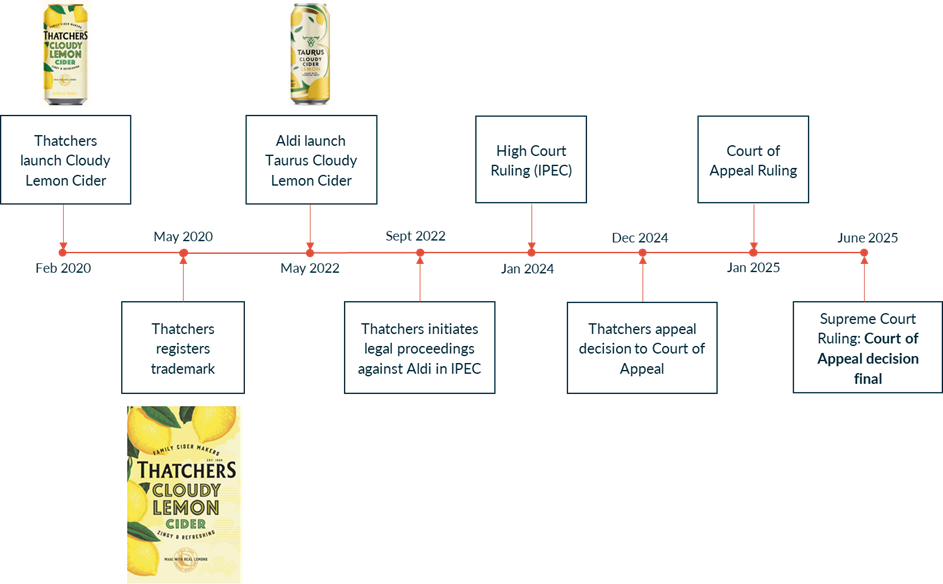
In 2020, Thatchers launched its Cloudy Lemon Cider, and in doing so, also registered the following trademark covering class 35 (Cider; Alcoholic beverages, except beer.)
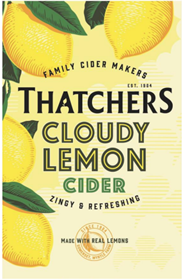
UK registered Trademark number UK00003489711
In 2022, Aldi introduced a remarkably similar product under its brand name Taurus (used since 2013).
Shortly after this, Thatchers initiated legal proceedings with the Court (specifically, Intellectual Property Enterprise Court – IPEC), alleging trademark infringement and passing off by Aldi.
Thatchers based its claim on the following grounds:
- Section 10(2) Trade Marks Act 1994 – Likelihood of Confusion:
Thatchers claimed that Aldi intentionally sought to create an association between the two products in the minds of consumers to drive sales of its own version.
- Section 10(3) Trade Marks Act 1994 – unfair advantage
Thatchers claimed Aldi took unfair advantage of the reputation of the Thatchers trade mark to benefit its own product.
- Passing off
Thatchers claimed it had established goodwill and reputation around its business and its Cloudy Lemon Cider. Thatchers claimed Aldi’s product misled consumers into thinking it was associated with Thatchers, thereby damaging its business and brand.
In January 2024, the IPEC ruled in favour of Aldi, dismissing all of Thatchers’ claims. The judge found a low degree of similarity and ruled that there was “no likelihood of confusion” between the two products. Notably, the Court did not find that Aldi had taken unfair advantage, despite acknowledging Aldi intended to create an association in the minds of average consumers between its product and Thatchers’.
This decision came as a surprise to some, especially in light of Aldi’s long-standing marketing message, “Like brands, only cheaper”, first adopted in 2011, which reflects its intentional approach to brand benchmarking.
Unsurprisingly, Thatchers appealed. In December 2024, it brought its case to the Court of Appeal, focusing solely on the Section 10(3) unfair advantage claim. Thatchers did not contest the decisions related to Section 10(2) or passing off.
In January 2025, the Court of Appeal overturned the IPEC’s ruling, siding with Thatchers. It held that Aldi’s Taurus Cloudy Lemon Cider had indeed taken unfair advantage of Thatchers’ trademark. The Appeal Court found that Aldi had deliberately benchmarked its product against Thatchers’, benefitting from Thatchers’ investment in branding and marketing rather than competing on its own merits.
The Appeal Court further found that the degree of similarity between the products had been understated by the High Court, which had placed too much emphasis on minor design differences. The judge stated: “It is clear that Aldi intended the Sign to remind consumers of the Trade Mark in order to convey the message that the Aldi Product was like the Thatchers Product, only cheaper.”
Aldi sought to appeal this decision to the Supreme Court on two grounds:
- The Court of Appeal’s ruling on Section 10(3):
Aldi argued the Court of Appeal was wrong to overturn the High Court’s finding and to rule in favour of Thatchers on the unfair advantage claim. - Aldi’s own defence under Section 11(2), Trade Marks Act 1994:
Aldi claimed the Court of Appeal misapplied this provision, which outlines exceptions to trade mark infringement.
The Result
On 12th June 2025, the Supreme Court refused Aldi permission to appeal, making the Court of Appeal’s ruling in Thatchers’ favour final.
The Supreme Court did not issue a detailed explanation behind their decision, but their message was clear.
The impact
This decision marks a significant victory for brand owners seeking to strengthen their position against lookalike products. The ruling confirms that copycat products can indeed take unfair advantage of a brand’s reputation and infringe its trademark, even when they are not exact copies.
It clarifies the courts’ differing views on what constitutes legitimate market competition versus exploitative mimicry, highlighting the complexities of trademark infringement and demonstrating why previous rulings have often seemed inconsistent or unclear.
Moreover, it reinforces the importance of brands having an intellectual property strategy for brand development and protection. Without Thatchers’ registered trademark, their ultimately successful claim under Section 10(3) would have lacked legal basis.
Will supermarkets continue to blatantly create brand dupes?
Will brands seize this moment to push back harder?
Throughout this long-running dispute, Aldi has shown little hesitation in pushing boundaries. Even as legal proceedings unfolded, Aldi launched its own version of Inch’s cider, an unmistakable copycat branded as Island’s, complete with the tagline: “Why have an ‘Inch’ when you can have an entire island.” Aldi appears to be testing how closely a product can mimic the original without crossing the legal line. Will this ruling spur Inch’s to take action? Or perhaps for Aldi, all publicity really is good publicity.
Final Remarks
It remains to be seen whether this court ruling will influence Aldi’s future branding strategies, or those of other supermarkets who have long relied on imitation to drive sales. But the message from the courts is now clear – the line between smart competition and unlawful mimicry does exist, and it is being enforced.
The case now stands as a significant precedent on trade mark protection for brands and the limits of “lookalike” products in UK intellectual property law.
For more information, contact us or call us on 01206 571187 to speak to one of our attorneys today.
Amy Sturgeon
Trainee Patent Attorney